
Home

About WCHS

Newport, MN

Part of Washington County Communities

Newport Public Library, ca. 1910

Compiled by Mary L. Keck, Oct. 1936

Ninety-nine years ago last June (1837) two Methodist ministers arrived at Fort Snelling to establish a mission among the Indians. They were accompanied by one John Holton, a young farmer from Pennsylvania, and his family. Mr. Holton settled at Red Rock, building his log cabin on the present site of the Pentecostal Camp Grounds. "The Unique Legacy of Red Rock and Newport" describes the area's history going back over 150 years.

After a short stay at the Fort, the missionaries retreated southward, following the west bank of the Mississippi Rover, and established a mission known as Kaposia on what is now the site of Swift & Company's Packing Plant at South St. Paul.

Two years later (1839) Rev. Benj. T. Kavanaugh of Ohio was appointed to take charge of this new work. Having some trouble with Chief Little Crow of the Sioux Tribe, Mr. Kavanaugh withdrew to the east side of the river and built a two-story log house in the forest at Red Rock. Here Mr. Kavanaugh lived during the four years of his oversight of the work.

In 1841 John A. Ford came from Illinois and joined the little company of settlers. He bought the 160 acres that was later sold to the Farmers' Terminal Packing Company, and which is now owned and occupied by the Cudahy Packing Company. The log house he built and lived in for many years on the riverbank was located just north of the main building of Cudahy's plant. Mr. Ford became an intimate friend of the Holton's and in 1843 married Mary Holton, daughter of John Holton. In 1844 their first son, Franklin C. Ford, was born, being the first white child born in Minnesota.

In 1843, after four years of faithful labor, Rev. Kavanaugh was removed and the mission abandoned. The two Kavanaugh children died while the family was located at Red Rock; the boy was drowned in a small lake adjacent to the river while attempting to get a pail of water for his mother. The graves of the Kavanaugh children were encircled with an iron fence and an inscription was placed on a slab, which still marks the burial place. Flowers are strewn over the little plot each Camp Meeting season as a tribute to their memory. In 1908 the log house built by Mr. Kavanaugh was taken down and moved to a place on the Camp Grounds where it was rebuilt and still stands, bearing the name "Kavanaugh Cottage".

The name Red Rock was given the location by the Sioux Indians on account of a granite boulder, which they found lying on the limestone bank of the Mississippi river just west of the site of the present camp meeting grounds. For long centuries the Indians regarded this builder with religious awe and made it an object of worship, smearing it with red paint. After the steamboat days were over this boulder was moved to the entrance of the grounds at the northeast corner of the ten-acre tract still occupied by the Association, and donated by John Holton to be used exclusively for camp meeting purposes.

The first post office in Washington County was in the store of John A. Ford at Red Rock, in 1844.

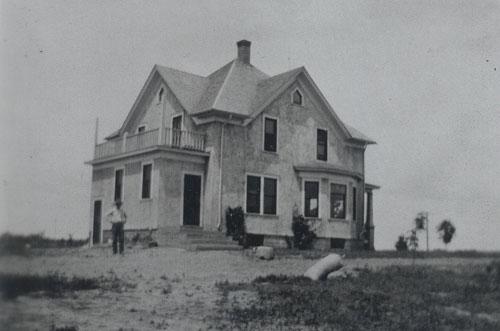
J.V. Bailey home ca. 1915

About 1850 R.C. Knox came to Newport and established a store and Indian Trading Post in a large warehouse building on the bank of the river immediately west of the R.W. Richardson residence. This building was a landmark for many years, used as a wheat warehouse, store, and in later years a dance hall and tenement building. Later this business was sold to Bixby Bros. And the post office was moved from Red Rock to Bixby's store. Mail came up the river once a week by steamboat.

Ruel Parker came to Newport from Rutland, Vermont, in 1852. He took tracts of land here on the Mississippi, also on the Minnesota River near Shakopee. Came in spring for ten years. In 1854 he brought with him John Willoughby. Mr. Willoughby began his home and moved his family from Vermont in 1858. Mr. Parker brought his family at the same time: built his home in Newport in May 1862.

Mr. Parker's son Charles was in the service in Louisiana. Charles came the next May, 1863; discharged because of a wound.

In 1854 James H. Huganin arrived in Newport and acquired considerable property in this locality. He bought out the Bixby store and in 1858 was appointed postmaster. He erected a large two-story square house on the corner of Main and Fourth. The first floor was used for a store, the second floor for a hall and was occupied for many years by the Good Templars as a lodge room. The Good Templars Lodge put on a theatrical show regularly every spring to replenish the treasury but no dancing was allowed in the hall as Mr. Huganin was a good Baptist and those were the days when dancing was not tolerated by the church. Alas! What would those good people think if they could come back today and see all the things carried on here in this beautiful village they strove to keep so clean.

In 1857 Shelton brothers came to Newport and built a small steam saw mill on the bank of the Mississippi river where the lagoon empties into the river. Several years later this structure was taken down and rebuilt on a larger scale on the high ground just north of the A.J. Green residence. These were the days when huge rafts of logs came down the river from the pine forests of northern Minnesota. Logging ranked second to the largest industry in Minnesota, the fur business being the most important. Later this second saw mill burned and was replaced by a flour and feed mill operated by E.M. Shelton and A.J. Scofield. After a few years the mill was leased to the late Riley Scofield and his brother, Harvey. In 1874 this building was destroyed by fire. The site was sold to Joseph Irish who conveyed it to Davis and Densmore. This firm built a two run flourmill and operated it for a period of ten years. It was then taken over by Henry A. Durand and A.J. Scofield, who operated it for a number of years. The building again burned and was never rebuilt.

About 1857, one Rev A.S. Lyon, a Baptist minister, came west and settled here. He purchased ground now owned and occupied by the Noltimier family and erected the small cottage (the main part of which is built of logs), which still stands on the same ground just south of the Noltimier residence. With about two exceptions this building is the oldest house in Newport that has weathered storm and fire.

Rev. Lyon, after getting established in a home, erected a rough building, the boards running up and down, close to his home in which church services and Sunday School were held on Sundays and day school weekdays, the parents of the children who attended day school paying a nominal sum for the privilege. There were three children in the Lyon family, two sons and a daughter. The daughter, Mary, and younger son, Albert, later went to China and Burma as missionaries of the Baptist faith.

The First Baptist Church of Newport was organized January 18th, 1859 with Rev. Lyon as pastor and G.H. Fowler as clerk. The first board of trustees of this new church was elected February 23, 1867, as follows: Wm. Fowler, O.V. Cowell, Samuel Fullerton, Levi Bailey, George Woodward, James H. Huganin and E.M. Shelton. They at once commenced the erection of a house of worship, which was dedicated March 17th, 1868.

This building has been used as a library building since 1889. When the church was erected most of the work was donated and lumber was much cheaper and of better quality in that day than at present. Butternut was used for the pews and inside finishing. This same butternut lumber, taken from the pews, was made into tables by the Library Board about ten years ago and will stand wear for as many years as it has already had. In 1870 the Baptist parsonage was built. This is the house north of the Library Building on Hastings Avenue. This same year, 1870, Newport's most sturdy and useful citizen arrived: Christ T. Shabaker, father of Wm. Shabaker, hardware merchant. Mr. Shabaker was proprietor of the only blacksmith shop in the township for over 40 years.

In the early days Newport grew very slowly and farming was almost the sole occupation. In April 1861, the Civil War broke out and President Lincoln issued a call for volunteers. Governor Ramsey responded for Minnesota by tendering 1,000 men. Almost every able-bodied man in this vicinity laid down his work to answer the call to defend his government. It is said that on this very sport where we are gathered, in the center of this group of oaks, forth-two men congregated to pledge allegiance to maintain the Union and enlisted in Company B, 3rd Minnesota, September 26th, 1861.

Following are the names of those enlisting from Newport as nearly as it has been possible to obtain them after seventy-five years have elapsed: Officers in the 3rd Minn., Co.B, Henry A. Durand and Johnathon A.Churchill; Privates, Giles H. Fowler, Ross Link, Fred S. Malike, J.W. Scofield, A.J. Scofield, Franklin Tibbetts, Peter Brunell, Orville Buck, Wm.Buck. 3rd.Minn. Co.F, John W.Wentworth; 6th Minn., Co.G, Wm.R.Brown; 6th Minn., Co.K, David Wentworth.

All of these men returned to their homes after the war excepting John W. Wentworth who died at DeVall's Bluff, Arkansas, in '64 and David Wentworth who died at Jefferson Barracks, Mo., the same year.

Following is a roster of the veterans of the Civil War who have been laid at rest in the Newport Cemetery: Andrew Blackman, Peter Brunell, ____Balter, Wm. R. Brown, Johnathon Churchill, Henry A. Durand, John Dezell, James B. Galbraith, _____Gellard, Anton McCoy; Henry C.Monroe, who enlisted at Spring Lake, Minn., and served under General Sibley in the Indian uprisings; __________Newberg, Isaac Ross, 33rd. Wisc. Inft. Robert Ross, 49th Wisc.Inft., Co.F, M.R. Seaman, 6th Minn., Capt.Short, 8th Ill. Cavalry, Capt. W.B. Silvis, 8th Minn., Co.I, enlised at Jordan, Minn., J.H. Stacy enlisted in New York, Franklin Tibbetts, 3rd Minn., Col. C.R. Wilkinson, enlisted at Chattanooga, Tenn., Co.I, 18th Ohio Inft., and C.A. Cressy who was a chaplain in the Spanish American War, stationed in the Philippines.

We still have among us our most honored and respected citizens (sole survivors of the Civil War) Charles A. parker, who enlisted in the Green Mountains of Vermont at the tender age of fifteen, and William R. Sawyer of St Paul Park, who enlisted in Maine. Both of these veterans have passed the ninety-year mark and we hope they may be permitted to remain with us many years longer.

Oct. 12th, 1865 Newport citizens met to consider the building of a Methodist church. Operations began in 1866 and the building was completed and dedicated in 1867. In 1898 this building burned and the present edifice was erected the following year, 1899.

Miss Elsie Scofield, daughter of Elias Scofield, and sister of Mrs. Archie McDonald, was the first organist after the society was in a position to purchase an organ. Elsie held this much-envied position for years until she married and became Mrs. Frank McCoy. Her father led the singing.

Newport still continued to be a river town, notwithstanding the Chicago, Milwaukee & St. Paul Railway extended their line from Milwaukee, Wis., to St. Paul in 1869. Giles Fowler, who is mentioned previously as enlisting in the 3rd Minn., Co. B, was appointed Station Agent and held that position for many years, operating a small farm in connection with his railroad work.

About 1876 the Diamond Joe Line which owned and operated a number of steamboats plying on the Mississippi River between St.Louis, Mo. And St.Paul, built a large warehouse on the south side of Main Street at the water's edge. Many thousand bushels of wheat, raised in this locality, were loaded on the steamboats from this warehouse and shipped down the river to the large markets in the south and East. The steamboats also carried the bulk of passenger traffic from St. Paul and other objective points down the river until 1880.

When Brown's add. Was added to Newport in 1872 the riverfront was gradually deserted until all business was transferred to the main highway, which was then the County Road, now designated as Hastings Avenue. Gradually river traffic ceased, the railroads carrying the entire load, which they can do very efficiently, there, being three Chicago main line roads running through the town for many years past.

The Cudahy Packing plant is our largest and most important industry, furnishing work for many of our townspeople as well as importing labor from surrounding communities. This industry is an asset to our village.

Newport has many distinctions for a small town of only a trifle more than 500 population. The assessed valuation of property in the village is far in excess of a half-million of dollars. We have a $31,000 accredited 8th grade school building, entirely modern; a public library founded forty-seven years ago and maintained solely by appropriation of village funds, with the exception of a small amount received from the county annually which must be used exclusively for the purchase of books. This gift makes the library free to anyone living in Washington County. The village owns the building, previously referred to as built in 1868 as a Baptist church.

Another distinctive feature is the Woman's Club, organized in 1892 and distinguished as one of the oldest clubs affiliated with the Fourth District Federation of Women's clubs.

Newport has sent three people as missionaries to the Foreign Field, the aforementioned Mary and Albert Lyon, and May Folwer, daughter of Wm.Fowler. Miss Fowler went to India as medical missionary from the Baptist church.

Henry A. Durand, veteran of the Civil War, served as postmaster in Newport for thirty years. Our sister village, Langdon, has a much greater distinction. She had a citizen who served the government in the capacity of postmaster for over fifty consecutive years, being appointed under the Hayes administration. This was the late Forrest E.Woodward, father of Mrs. Mary Bailey, who is sponsoring this meeting. Newport's most outstanding distinction - she was "dry" for 95 years - until the Roosevelt administration.

You may be interested to know that the name of Newport was given to the little settlement by Mrs. James H. Huganin, the wife of the man whose name has appeared several times in these pages and who was identified with every forward movement in this village so many years ago.

More: Washington County Communities >>>