The touring season always flies by so quick! Although time may be just zipping by because of all fun events we were able to host this year!
In no particular order, we were fortune enough to welcome Rep. Dean Urdahl, Afton Historical Society Vice President Ken Martens, current Minnesota State Prison Warden Michelle Smith, author John Christgau, the Johnsdale Paranormal Group, author Bruce Kohn, and filmmaker Tristan Jensen, for various presentations and lectures. This summer has had some of the best attended events in recent memory and we can’t wait to show you what we have planned for next year!
And a special thank you needs to be extended to all of WCHS’ wonderful volunteers (pictured in the lower center). I can’t imagine running these events or bringing 90 high school students through the museum without all your help!
OLD NEWS
It Could Be Colder, Folks
Although this week has been pretty mild, I was starting to become a little worried as the temperature dipped at the tail end of last week. When I came across these chilling reports from the Stillwater Messenger in 1905, I suddenly realized I really didn’t have anything to complain about…
News Briefs – Stillwater Messenger – November 4, 1905
Anton M. Peterson, a traveling salesman, fell from the roof of his dwelling on Laurel street while shoveling snow Thursday afternoon, and sustained a sprained back and dislocation of his left wrist. He may be injured internally, as he fell on a stone sidewalk.
The Atwood B mill was forced to shut down on Friday of this week on account of the ice in the river. The South Stillwater mills are still running but will likely stop operations within a few days. The Hudson mill closed last week.
FEATURED ARTICLE
Republicans and Democrats Wouldn’t Play Nice in 1857 Either!
by Bob and Nancy Goodman
By 1856, Minnesota had more than enough inhabitants to qualify for statehood, and had had them for several years. There were advantages to remaining a Territory, such as federal financing of the territorial government, which may have accounted for the delay. But in 1856 there appeared the possibility of getting a juicy land grant for railroad construction, which would only be available to a state. In December Delegate Henry M. Rice started the statehood ball rolling.

President Franklin Pierce signed the Minnesota Enabling Act on February 26, 1857. The Act authorized the people of the Territory to hold an election on the first Monday in June, 1857, to select delegates to a Constitutional Convention. If the voters and Congress approved the Constitution there written, Minnesota would become a state.
There was an election battle between the Democrats and the new Republican Party. The prize would be the first apportionment of legislative districts in the new state. Most expected the districts would be drawn to favor the party that controlled the convention. If that party then won a majority of both houses of the legislature it could elect two new United States Senators, and so many persons in and out of the territory became much interested in the June election. The Republicans sent in money and high-caliber outside speakers. The Democrats relied on the federal patronage machine of hundreds of office-holders from the local postmaster up to the governor. In Washington County the Democrats carried the day, sending eight members to the convention.
The eight were William Holcombe, James S. Norris, Henry N. Setzer, Gold T. Curtis, Newington Gilbert, Charles J. Butler, Reuben Sanderson, and Charles G. Leonard. Holcombe, Setzer, and Curtis often spoke in the convention; the others were mostly silent.
Holcombe had been a delegate to a previous constitutional convention, representing the St. Croix Valley in the Wisconsin Constitutional Convention in 1846. He had been prominent in the Democratic Party in Washington County since 1840. Setzer had been in the last Territorial Legislature; he was a Missouri native and the most pro-Southern of the county delegates. Curtis was a relative newcomer, a Stillwater lawyer with some good clients; he was chair of the county Democratic organization. Norris, “The Sage of Crescent Hill,” had served in the Legislature and had been speaker of the House.
Of the others, Newington Gilbert was an early settler in the Valley Creek area; Charles Butler was a lumberman in Marine and Stillwater; Reuben Sanderson was a builder and town official in Lakeland; Charles Leonard had been Territorial treasurer. A former Washington County resident, Joseph R. Brown, was also a delegate, but now from Sibley County.
The election returns elsewhere could give a majority to either party, depending on disputed elections. On the day set for the first meeting of the convention, the two parties collided, held a shouting match and split into two, each loudly claiming their right to be the only true convention.
Both conventions set to work. There were many models of the basic laws of other states to work with, and little controversy on most clauses in either body. One issue was the state boundary. Some delegates in both factions proposed an east-west line running a few miles south of St. Cloud. Both parties rejected the idea. Another issue among the Republicans was voting rights for African-Americans, also rejected.
Gold Curtis introduced two amendments including: “…..a provision for securing to married or single women, in their own name, and independent of all control by any male person whatsoever, their real and personal property whenever acquired,” which was adopted. Setzer proposed an addition: “And the right of suffrage and holding office shall be secured to married women.” The change was rejected.
Curtis’ other amendment provided that: “The Territorial Prison, located under existing laws, shall, after the adoption of this Constitution, be, and remain one of the State Prisons of the State of Minnesota.” The provision remained long after the old prison at Stillwater was closed, and was finally removed in a cleanup of obsolete clauses in the constitution.
As the days went on it appeared that there would be very little difference between the two constitutions. Joseph R. Brown had the idea of two constitutions identical in content, so that neither side would appear to have surrendered to the other, and set to work getting both sides to agree. A resolution incorporating a compromise plan was introduced in both conventions, and adopted without debate by the Republicans. On the Democratic side the resolution was postponed indefinitely. Setzer was among those strongly opposed. Setzer said, “If we must go and beg other men to acknowledge us, I want no further connection with the constitutional convention.” Calls of, “Nor I, Nor I.” Brown replied: “I would merely provide that a Committee shall be appointed to take into consideration in what manner one Constitution shall be placed before the people, instead of two.”
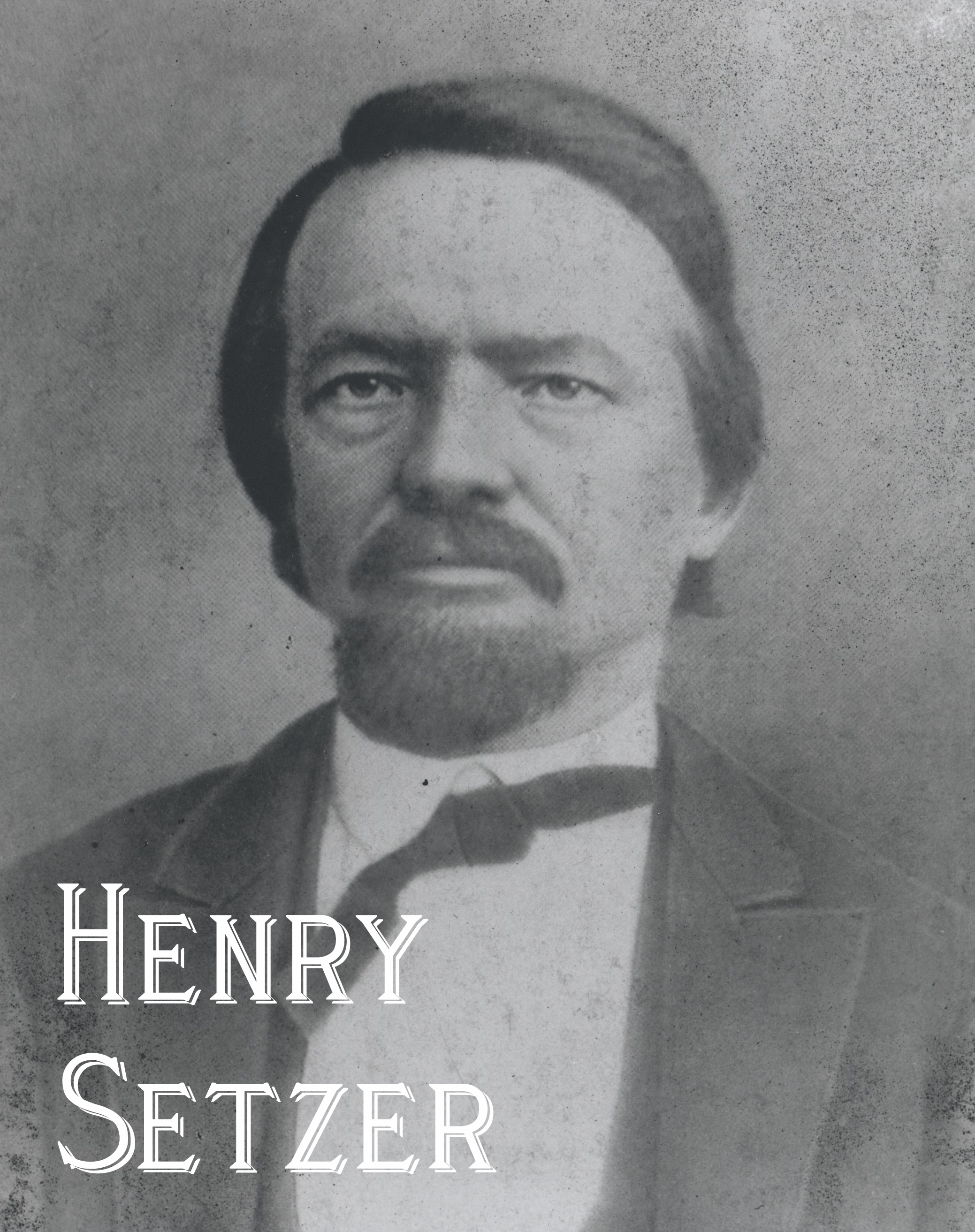 The issue soon arose again, and a committee including Brown, Holcombe, and Setzer was named to consider agreeing on a single constitution with the Republicans. The majority report favored seeking an agreement, and the convention adopted the report. Seven members, including Setzer, voted against it. Setzer walked out, saying “Mr. President, as this body has, by a majority of its members, decided that it is no longer the Constitutional Convention, I should resign my seat if there was an authority to whom I could tender that resignation. As it is I shall simply leave the hall.” Moses Sherburne replaced Setzer on the compromise committee. A few days later the sergeant-at-arms, sent to arrest the absentees, produced Setzer at the door of the convention. He took his seat.
The compromise committee produced a constitution identical to the Republican version. Setzer exploded: “Since the Black Republicans have sacrificed their principles, we can afford to sacrifice the offices…. they have agreed upon an apportionment which is unfair and one-sided in every respect…(which) will give a majority of both houses of the Legislature into the hands of the opposition. The gentleman asks if we cannot sacrifice our individual opinions for the good of the whole. Sir, I am a Democrat for the good of the whole. Gentlemen take a good deal of credit to themselves for having sunk all partisan feeling in this matter. For one, I will not sink my partisan feeling….”
The convention adjourned for private discussions. Doubtless some heads were knocked and some arms twisted.
When the convention resumed, no amendments were accepted to the report. Several delegates said that the report was the best that could be had, and it was time for one constitution to be approved and statehood achieved. Joe Brown observed that the split conventions were all for the best, for if they had met together they would still be battling over the first clauses the next January. The final vote on adoption showed thirteen opposed, only Setzer among them from Washington County. However, he did sign the constitution.
The compromise Constitution was presented to the people of Minnesota Territory on October 13, 1857 and was easily approved by the voters. At the same election the first state officers and legislators were selected. Delegate Setzer’s fears about the apportionment proved groundless, for the Democrats carried the election. Interestingly, these gentlemen ran for offices in a state that didn’t exist under a constitution that had not been ratified. But these minor irregularities did not prevent Minnesota becoming a state on May 11, 1858. William Holcombe became the first lieutenant governor, and Setzer was named warden of the Stillwater prison.
Not one to ever truly bury the hatchet, Setzer held the position until 1860 – when he resigned in protest of Republican Abraham Lincoln’s election as President.