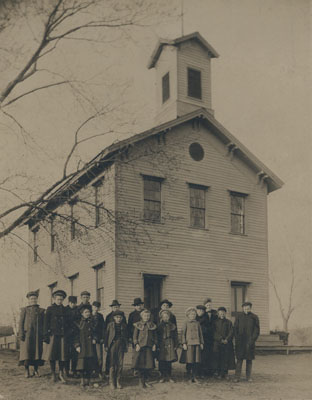
Originally created in 1851, District 21 extended from the St. Croix River to just north of St. Croix Beach and surrounded the Lakeland community.
For its first decade, the school district didn’t actually have a school. Classes were held in various generous community members homes. Obviously, a long term solution had to be devised.
In 1869, the two-story wooden building in the photograph above was constructed for a cost of around $6,000. Grades 1-4 were held downstairs and Grades 5-8 were upstairs. At it’s height, Lakeland School had around 100 students and each grade was held in a different classroom. However, as cities and population centers became more established, by 1938 only 42 students attended Lakeland School regularly.
In the fall of 1948, the school burned to the ground and the district was absorbed by the nearby Afton district.
Over the years, WCHS has been fortunate enough to collect a few memories of this extinct school district from its former students.
“There was no electricity in the schoolhouse when I started. There were kerosene lamps in side brackets on the walls near each window. When a suggestion was made to the school board [for electricity]…Andrew Nelson addressed my father with a strong Swedish accent and said ‘Sixty years ago when I went to school we didn’t have ‘lectric lights. If your girl needs glasses, take her to the doctor.’ I did get glasses at age eleven and District 21 got electricity!” – Peggy Wolter
“The teachers rode to school on the school bus from old Stillwater Motor. This bus returned to Stillwater with the high school pupils. The teachers then returned from Lakeland to the old Stillwater Motor Garage.” – Marcella Schrank Fisher
“The huge coal stove with the ornate jacket that kept us warm in winter…the ice slide we made and tore down on our feet or on chunks of cardboard. It’s a wonder we didn’t break our necks.” – Mavis Smart Johnson
Old News
A Bit More Involved Than Kraft
I probably still have food on the brain because of Thanksgiving …but doesn’t this sound delicious?!
Macaroni With Cheese – Stillwater Messenger – December 2, 1911
Wipe a nice quantity of macaroni with a clean, dry cloth, break and throw it into boiling, salted water. Let it boil until it yields easily to pressure between the fingers. Drain it in a colander and rinse it thoroughly in cold water. Put into a saucepan 1 ounce each of butter and flour, and stir them together over the fire until they form a thick paste. Heat a cup of half milk and water to the boiling point and stir gradually into the butter and flour, season to taste with pepper, salt and a dash of nutmeg, add the macaroni; grate two ounces of hard, dry cheese and when the macaroni is quite hot stir in the cheese. Sprinkle with bread crumbs, add a few bits of butter and stand in the over just long enough to brown.
Featured Article
The First People of the Valley
by Bob Goodman, from “A History of Washington County: Gateway to Minnesota History“
Humans have lived in the St. Croix and Mississippi River valleys for about 12,000 years. The earliest prehistoric tradition was that of Paleo-Indian nomadic people who hunted big game such as mastodon and bison. From 10,000 to 3,000 years ago, Archaic tradition people, makers of stone tools, may have lived or hunted here. Woodland culture people of about 2,500 years ago produced the mounds that are still visible in parts of the county. These people made pottery and also began to raise crops.
Grey Cloud Island was an important place for the Woodland mound-buildings (c.600 B.C. to 600 A.D.) and for people of the Late Mississippian culture around 1000 A.D. These people used the Mississippi River as a conduit for trade and settlement. By the nineteenth century the Mdewakanton Dakota had moved into the area.
The Dakota, called Sioux by Euro-Americans, originally lived in central and northern Minnesota around Mille Lacs Lake, which is where Father Louis Hennepin found them in 1680. Their name, Mdewakanton, means “people of Spirit Lake.”
By settlement times the Dakota had been pushed south by Ojibwe people known to early settlers as Chippewa. Dakota and Ojibwe had a history of conflict and keep some distance between their settlements, with the nearest Ojibwe villages on Pokegama Lake in Pine County and the Dakota mainly on the Mississippi and Minnesota Rivers. Washington County was in general a no-man’s land, home only to hunting and war parties.
The United States established an agency for the Dakota at Fort Snelling in 1820. In 1825 the rival groups were persuaded to sign a peace treaty and accept a U.S. government-surveyed dividing line between them that followed approximately the northern line of the county. It did not really keep them apart, as both Dakota and Ojibwe came to the Indian Agency at Fort Snelling. Both groups continued to use the St. Croix and Mississippi rivers as a highway to the fort.
By the early 1830s a splinter group of about 40 families from the Kaposia Dakota band headed by Medicine Bottle had moved to Grey Cloud Island. Their village of bark houses was on the northwestern part of the island. No other Indian villages appear to have existed in the confines of the county at this or any later time.
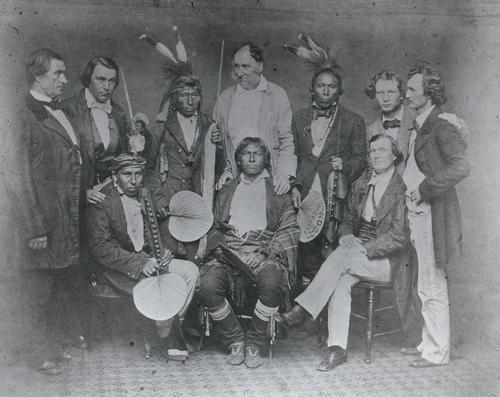
Dakota Treating Signing – 1837
The St. Croix River was included when Wisconsin Territory was established in 1836, but the land between the St. Croix and Mississippi rivers was still unceded Indian land. Lumbering interests put pressure on the U.S. government to purchase the pine lands of the St. Croix. In July of 1837, Governor Henry Dodge of Wisconsin Territory met with the Ojibwe at Fort Snelling, where a treaty was signed ceding all lands of the Chippewa between the Mississippi and St. Croix rivers up to the 46th parallel to the United States. Another treaty was signed in Washington D.C. that September with the Dakota, who had claimed the lands now included in Washington County. The treaties were ratified in 1838. The few Dakota living in the county moved into unceded land west of the Mississippi.
The two nations still clashed. After an altercation in 1839, the Dakota pursued the Ojibwe to a camp on the St. Croix River in the ravine north of Stillwater and fired into theirs midst, killing more than 20. The ravine, later the site of the Territorial Prison, became known as “Battle Hollow.”
Wisconsin Territorial Governor James D. Doty negotiated a treaty with the Dakota in 1841 that would have opened all of southern Minnesota to settlement. But Congress did not agree to the terms, and it was another 10 years before the press of settlement necessitated the purchase.
In July 1851, Alexander Ramsey, Minnesota Territorial Governor, and Luke Lea, Commissioner of Indian Affairs, signed treaties with the Dakota at Travers des Sioux and Mendota that opened the vast “Suland” of southern Minnesota to settlement and consigned the Dakota to reservations along the Minnesota River, opening the floodgates to immigration.

 On Saturday, January 17th, the Washington County Historical Society you to a Winter Ice Cream Social, which runs from Noon – 4:00 PM.